The commercial composting operation at 617 McKenzie Road is operating in contravention of ALC Non-farm use Permit and Organic Matter Recycling Regulation OMRR
Abbotsford Agriculture Committee Report May 9 2018 Page 23
Abbotsford Council Minutes February 12, 2019
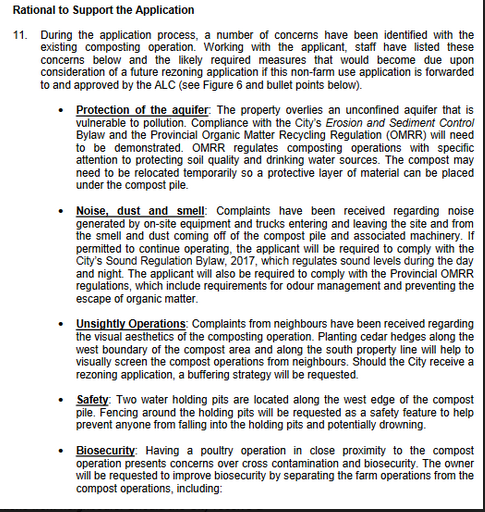
Abbotsford Council Minutes February 25, 2019 support the application to the Agriculture Land Commission for Non-farm Use
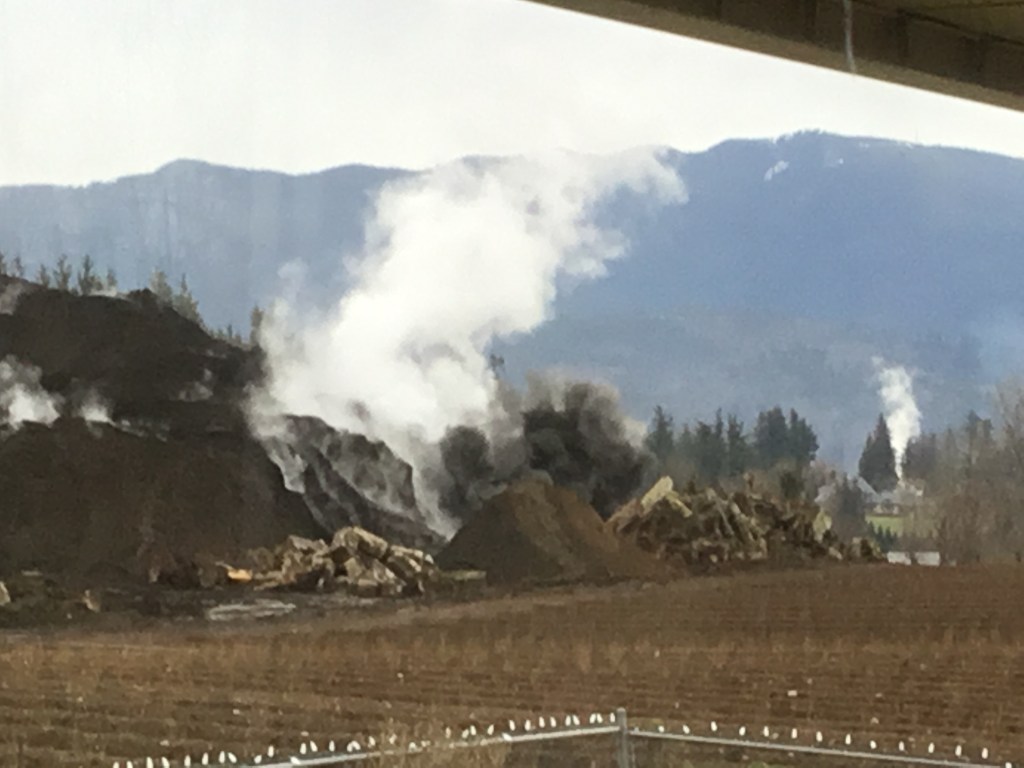
Agriculture Land Commission Non-farm Use Permit with Conditions that are NOT being complied with:
Inspections of Lifesoils / Dahl compost operation by Ministry of Environment
Warning letter from Ministry of Environment March 7 2022 regarding leacatte risks to aquifer
Organic Matter Recycling Regulation
Excerpt from Invitation to the City of Abbotsford to Meet Its Obligations for Good Government Regarding the Rezoning for Commercial Composting at 617 McKenzie Rd (Cc to ALC Minister of Agriculture and Minister of Environment)
Consequences to Ongoing Bylaw Infractions
i. Although the City became formally aware of this non-compliant activity in 2015, there has been no bylaw enforcement, and therefore no incentive for the Dahl family to work towards compliance.
ii. Of the last five non-farm use applications where Mr. Brian Gaudet was the agent, and which were approved by the ALC, none of them have proceeded to a rezoning process. Some of these applications were made in 2016.
iii. None of the five non-farm use applications referred to in (ii) above where Mr. Brian Gaudet was the agent, were subject to bylaw infractions, despite more than 20 years of non-compliance for some of the industrial activities on the agricultural land.
iv. In accordance with the Development Application and Procedures Bylaw, the application for rezoning has lapsed and the file is closed, given that City staff noted that the application had been submitted in 2020.
v. Part 8 of the Community Charter provides tools and consequences for non-compliance. The neighbours are aware that the City uses these tools including prosecution for bylaw offenses. These include non-compliance regarding commercial truck parking on agricultural land.
vi. The neighbours are aware based on other cases within the City, that if they chose to park three commercial trucks on their rural properties, they could expect bylaw infraction notices immediately, with provincial prosecution following if they chose not to comply. The parking of three commercial trucks has relatively no impact on the neighbours or the environment, especially in comparison to the ongoing compost facility with no protection to the groundwater, and the ongoing smoke and discomfort of the neighbours
vii. The City’s response is completely contrary to the City’s Bylaw Compliance Policy (C006-08) which outlines priorities for bylaw enforcement where Priority # 1 is described as: “the alleged bylaw contravention has the potential to cause material adverse impact to the environment and public safety.” “These types of calls will be responded to as soon as possible, based on available staff resources” and “Prior warning or education may not be appropriate in these cases.”
Invitation to the City of Abbotsford to Meet Its Obligations for Good Government Regarding the Rezoning for Commercial Composting at 617 McKenzie Rd :
Impact Statements from Neighbours
Email from Abbotsford Fire Department regarding burning concerns

Response from Minister of Environment Heyman referring affected residents to check the Natural Resource Compliance & Enforcement database and report future concerns via RAPP Web Contact Form
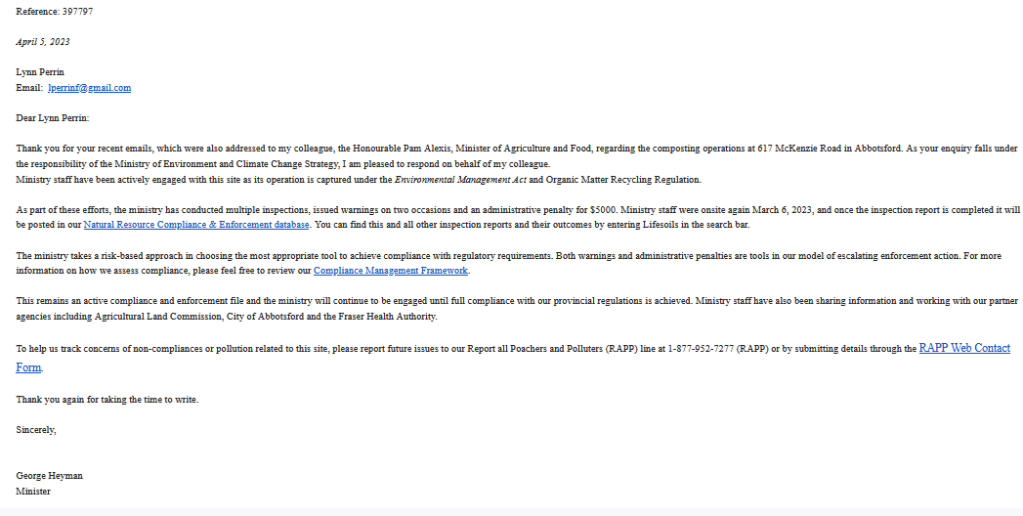
Re: An Administrative Penalty Referral
Only 1 reference to “fire” and 0 references to smoke
Page 3
Environmental Management Act, Organic Matter Recycling Regulation (18/2002)
(EMA)
12 (3)(b): Compost that is not solely produced from yard waste or from untreated and unprocessed wood residuals and that meets the requirements of all of the following is Class A compost: (b) Schedule 3, Pathogen Reduction Limits;
Schedule 3 of OMRR includes the following requirements:
• Section 1 – Fecal coliform levels must be determined to be less than 1000 MPNper gram of total solids (dry weight basis) for Class A compost (not produced from yard waste alone);
• Section 3 – For Class A compost (not produced from yard waste alone), 7
representative samples must be taken from every 1,000 tonnes of dry weight, or once per year whichever occurs first;
• Section 5 – Fecal coliform levels for Class A compost (not produced from yard waste alone) must be met either before, or at the same time as, the vector attraction reduction requirements are met; and,
• Section 6 – Fecal coliform levels must be met, and vector attraction reduction methods must be complete before Class A compost is prepared for distribution.
Officer Angus reviewed the Email Correspondence provided by the Senior Environmental Scientist and determined the following:
• Section 1 – Fecal coliform levels were less than 1000 MPN per gram of total solids (dry weight basis) for the analysis conducted in February 2023. No other sample results were provided, therefore compliance with this requirement could not be determined for the entire Inspection Period.
• Section 3 – The Owner informed Officer Angus on April 16, 2023, that from January 13, 2022, to January 31, 2023, 16,192 m3 (9,715.2 tonnes) of compost was produced and distributed off-site, equating to more than 2,000 dry tonnes; however, only one set of seven samples was provided for the Inspection Period when at least two sets of samples should have been provided.
• Sections 5 & 6 – As identified in the previous Details/Findings Section
12(2)(b), Officer Angus determined that LifeSoils did not meet the Vector
Attraction Reduction requirements.
As the appropriate amount of representative samples was not collected, and the requirements for Schedule 2 Vector Attraction Reduction of OMRR were not met, LifeSoils
is out of compliance with the requirements of this Section.
Compliance: Out
Page 5
Schedule 6 of OMRR includes the following requirements:
• Section 1 – Temperature and retention times must be monitored and recorded each working day during the production of Class A compost (not produced from yard waste alone).
• Section 3 – Results of analysis required by this regulation must be kept at the facility for at least 36 months after the production of Class A compost (not solely produced from yard waste).
• Section 4 – Results of Analysis must be made available for inspection by an officer, or sent to an inspector, upon request.
Compliance Assessment:
• Section 1 – Officer Angus reviewed temperature and retention time data, which demonstrated that LifeSoils monitored temperature and retention times for each working day of production for 2022.
• Section 3 – LifeSoils was unable to provide Officer Angus and Officer Howett with analytical results during the on-site inspection at the Facility.
• Section 4 – Analytical results were not provided to Officer Angus despite repeated requests.
Compliance: Out
Page 6
Requirement Description: Environmental Management Act, Organic Matter Recycling Regulation (18/2002)
(EMA)
23 (2)(a): A discharger must ensure that no organic matter is collected at, and no compost is distributed from, a composting facility unless a qualified professional conducts and completes an environmental impact study and produces an environmental impact study report acceptable to a director which includes, but is not limited to, (a) design of the
composting facilities including buildings, works and other appurtances,
Details/Findings: The 2021 Notification Form for Construction of Beginning Operation of a Compost Facility stated that the design production capacity for the Facility would be 20,000 tonnes per year.
As a result, the 2021 Acknowledgement Letter specified that an Environmental Impact Study (EIS) was required to be completed and submitted to the Ministry by September 30, 2021. The Ministry provided an extension for the submission of the EIS to February 15,
2022; however, LifeSoils submitted their EIS to the Ministry on March 2, 2022, 15 days after the extension deadline.
The Ministry reviewed the EIS and returned it as unacceptable on November 29, 2022. The Ministry provided LifeSoils with a second EIS submission extension date of January 31, 2023. The Senior Environmental Scientist requested a third extension on January 17,
2023; however, the Ministry declined the extension request on February 22, 2023. Since LifeSoils continued to collect and distribute organic matter throughout the Inspection Period, without an acceptable EIS, LifeSoils is out of compliance with the requirements of Sections 23(2)(a), (b), and (c).
Compliance: Out
Page 6
Environmental Management Act, Organic Matter Recycling Regulation (18/2002)
(EMA)
25 (2)(b): The notification required by subsection (1) must include (b) a copy of a personnel training program plan that addresses the specific training needed to operate the composting facility in compliance with this regulation.
Details/Findings: The 2021 Acknowledgement Letter indicated that LifeSoils was to “submit a revised personal training program plan in accordance with the Compost Facility Requirements Guidance (Appendix B). The submitted personnel training program plan does not have
sufficient training provisions. A copy of the guidance is available at the following link:
https://www2.gov.bc.ca/assets/gov/environment/waste-management/organic-
waste/biosolids/compost-facility-req.pdf “. The revised training plan was to be submitted by September 20, 2021.
Officer Angus reviewed the correspondence on file and determined that LifeSoils has not submitted a revised Personnel Training Program Plan, which meets the requirements of this Section and is therefore found to be out of compliance
Compliance: Out
Page 8
During the on-site inspection, Officer Angus and Officer Howett observed the Facility’s receiving, storage, processing, and curing areas. Officer Angus and Officer Howett observed that the receiving, storage, and curing areas were located either under a cover/roof or on a prepared surface designed to prevent the surface collection of water around the base of the organic matter and compost (Photos 1 through 4). However, Officer
Angus and Officer Howett observed that the processing area had concrete only to the midpoint under the compost pile, and beyond the midpoint, the pile was located on bare ground, and the surface collection of water around the base of organic matter was observed (Photos 5 and 6). Since the Facility did not have a roof or prepared surface
designed to prevent the surface collection of water around the base of organic matter and compost throughout the entire processing area, LifeSoils is out of compliance with the requirements of this Section.
The previous IR182205, dated March 7, 2022, determined that LifeSoils was out of compliance with Section 26(2)(b)(i) of OMRR for not ensuring that all areas of the composting Facility (receiving, storage, processing and curing) were undercover, or on a prepared surface designed to prevent the surface collection of water around the base of organic matter and compost. Officer Angus observed water collecting around the base of
the receiving area. The Ministry response for IR182205 was a Warning.
The non-compliance associated with Section 26(2)(b)(i) of OMRR is being referred for an
Administrative Penalty
Compliance: Out
Page 9
Officer Angus and Officer Howett observed the Facility’s receiving, storage, processing, and curing areas during the on-site inspection. Officer Angus and Officer Howett observed that the receiving, storage, and curing areas were located either under a cover/roof or on a prepared surface designed to prevent run-off water from entering these areas (Photos 1
through 4). However, Officer Angus and Officer Howett observed that the processing area had concrete only to the midpoint under the compost pile, and beyond the midpoint the pile was located on bare ground, and the surface collection of water around the base of organic matter was observed (Photos 5 and 6). Since the Facility did not have a roof or
prepared surface designed to prevent run-off water from entering the entire processing area, LifeSoils is out of compliance with the requirements of this Section
Compliance: Out
Page 9
When observing the receiving, storage, processing and curing areas, Officer Angus and Officer Howett observed that there was no leachate collection system designed, constructed, maintained, and operated to reuse or remove leachate. The Senior Environmental Scientist informed Officer Angus that two 70,000 L tanks had been purchased to collect leachate but still needed to be installed.
The previous IR182205, dated March 7, 2022, determined that LifeSoils was out of compliance with Section 26(2)(c) of OMRR for not ensuring that all areas of the Facility had a leachate collection system. The Ministry response for IR182205 was a Warning.
The non-compliance associated with Section 26(2)(c) of OMRR is being referred for an Administrative Penalty.
Compliance: Out
Page 10
Environmental Management Act, Organic Matter Recycling Regulation (18/2002)
(EMA)
26 (3): Leachate that is not collected and reused in the composting process must not be discharged into the environment unless authorized under the Act.
Details/Findings: Since the previous inspection (IR#182205), the Senior Environmental Scientist informed Officer Angus that the stormwater collection sump had been filled in. The Senior Environmental Scientist also informed Officer Angus that water was used to suppress the
fires that occurred on October 9 and November 28, 2022, and then the water was subsequently reintroduced into the composting process (IR203661).
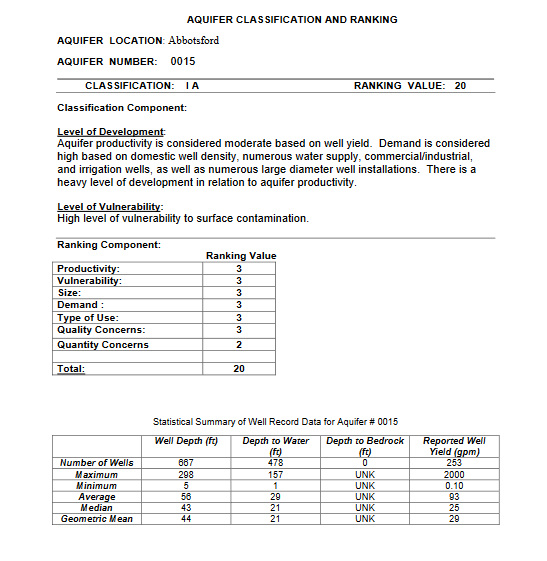
As identified in previous inspection reports (IR#128402 and IR#182205), there are two mapped aquifers located beneath the Facility that are separated by glacial till but likely to be hydraulically connected. The upper aquifer consists of sand and gravel, has a relatively shallow water table (10 m below ground surface), and is highly productive, with many wells pumping at rates greater than 10 L/s. As such, the aquifer was determined to be highly vulnerable to contamination (Attachments 1 and 2).
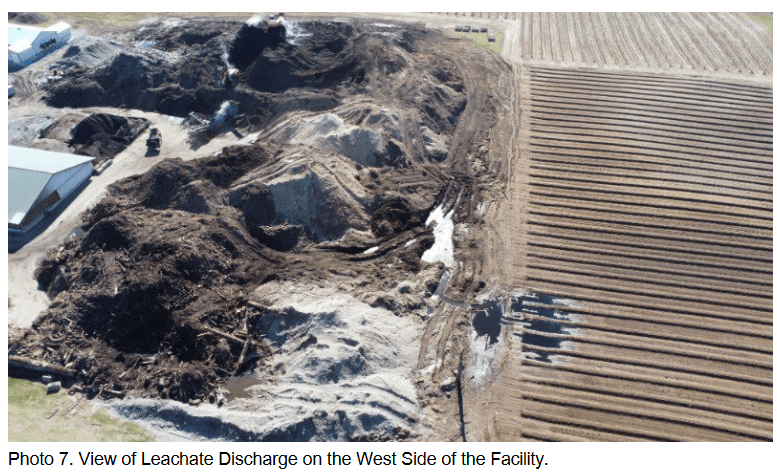
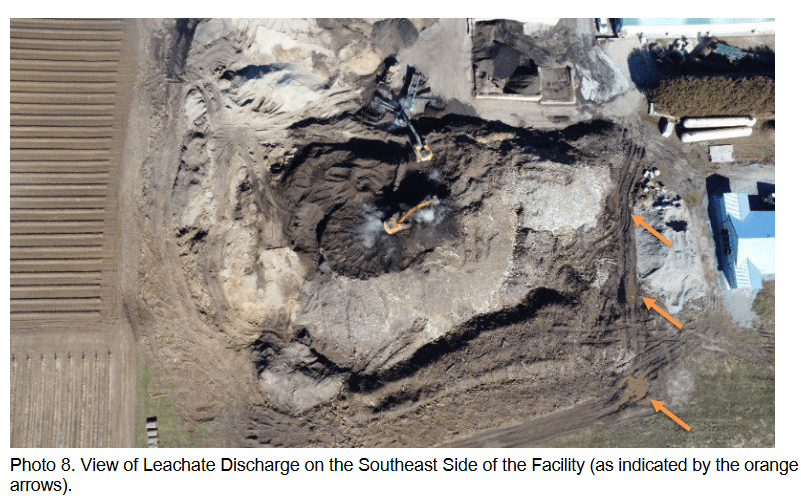
During the inspection, Officer Angus and Officer Howett observed leachate being discharged to ground near the storage and curing area where concrete was removed, on the west side of the Facility and on the southeast side of the Facility (Photos 7 and 8).
No sections in OMRR authorize these discharges, and Officer Angus confirmed that these discharges were unauthorized.
The previous IR182205, dated March 7, 2022, determined that LifeSoils was out of compliance with Section 26(3) of OMRR for not collecting and reusing leachate in the composting process and for discharging leachate into the environment. The Ministry response for IR182205 was a Warning.
The non-compliance associated with Section 26(3) of OMRR is being referred for an Administrative Penalty
Compliance: Out
Page 12 ” Class Acompost is defined in OMRR as “compost that meets the requirements of Section 12”.
LifeSoils was determined to be out of compliance with Sections 12(3)(a), 12(3)(b), 12(3)(c), and 12(3)(d), as detailed above in this inspection report. Since LifeSoils failed to comply with sections 12(3)(a), 12(3)(b), 12(3)(c), and 12(3)(d) of OMRR, the material produced during the Inspection Period is considered a waste and not Class A compost. By distributing this material to a third party, LifeSoils has caused, or allowed, waste produced during a prescribed operation to be discharged into the environment and is thereby out of compliance with EMA Section 6(3).
Compliance: Out
Has the “Senior Scientist ” breached his professional due diligence According to the Professional Governance Act: undermines the principle of holding paramount the safety, health and welfare of the public, including the protection of the environment and the promotion of health and safety in the workplace in the manner that reflects the stewardship of a given profession by each regulatory body.
Abbotsford neighbourhood under a cloud after manure fire at composting facility
“The Morellis and their neighbours said the decade-long merry-go-round between different authorities has left them feeling frustrated as the compost operation has continued almost unhindered. They’re hopeful the stop work order issued by the Abbotsford Fire Department will lead to changes.
The order was issued as a precaution against a fire hazard, said the statement from the City of Abbotsford: “The properties have an accumulation of combustible materials and vegetation. While there is not a current fire, the product is self-heating and does steam.”
Several conditions for fire safety must be met for operations to resume
The fire department has issued a stop work order at a composting facility that has been the subject of complaints for almost a decade.”
Response from Abbotsford that a Rezoning Application passed First and Second Reading in spite of serious findings of NON COMPLIANCE
Report to Council https://abbotsford.civicweb.net/filepro/document/57479/PDS%20073-2023%2C%20Rezoning%20application%20(617%20McKenzie%20Road).pdf
Letter of Opposition /Analysis of Report PDS073-2023
BRAVO Abbotsford Council voted NO to rezoning and YES to clean air and safe drinking water!
November 2024
Nearly 10,000 people in Abbotsford, B.C., have been told to boil their water after E. coli bacteria was detected in a private provider’s water system on Thursday.
 Sustainable Agriculture in the Fraser Valley